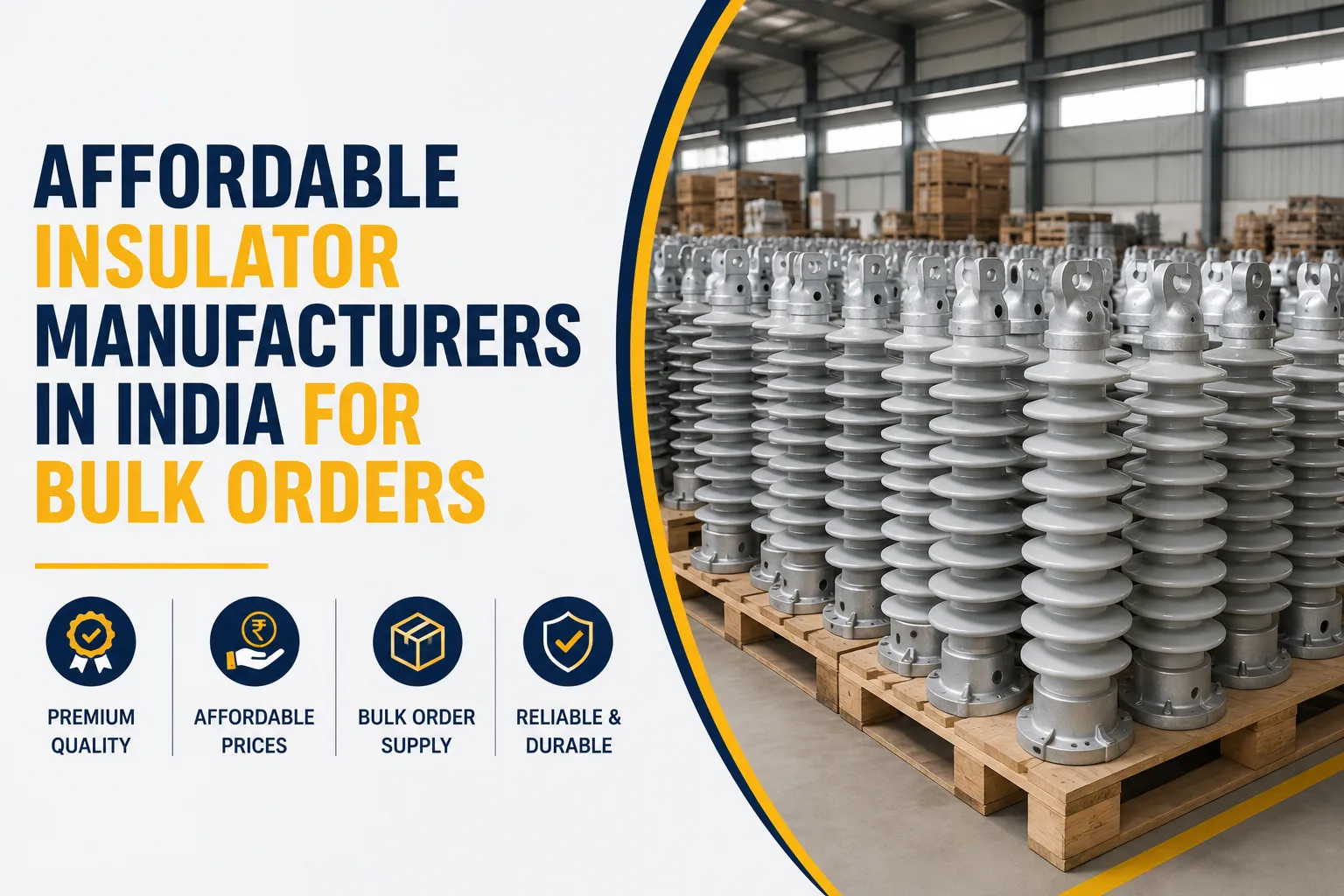
I have sat through enough procurement meetings to know the real question procurement managers ask is rarely "who is the cheapest." It is "who can deliver consistent quality at scale without me chasing them every week." If you are evaluating insulator manufacturers in India for a large order, this guide walks through exactly what separates a dependable bulk supplier from one that will cause you headaches three months into the contract.
Why Bulk Insulator Sourcing Is Different From Small Orders
When you order ten insulators for a repair job, minor inconsistencies barely register. When you order a thousand units for a transmission line project, even small variances in dimensional accuracy or dielectric strength across the batch can cause installation problems on site.
I have seen EPC teams reject entire container loads because the flashover voltage varied more than acceptable tolerance across units from the same production run. That is a scheduling disaster nobody wants, especially on a project with a fixed commissioning date.
This is exactly why bulk buyers need to evaluate manufacturers differently than retail buyers. Production capacity, batch consistency, and testing discipline matter far more than a low quote on paper.
What Is an Electrical Insulator, in Simple Terms
Before going further, it helps to align on the basics. An insulator is a non-conductive component that mechanically supports an energized conductor while preventing current from leaking to the tower, structure, or ground.
Without reliable insulators, transmission and distribution lines simply cannot function safely. They carry mechanical load, resist electrical stress, and withstand years of sun, rain, pollution, and temperature swings without failing.
The Two Main Materials: Porcelain vs Polymer
Most bulk orders in India fall into one of two material categories, and understanding the difference helps you specify correctly.
| Factor | Porcelain Insulators | Polymer Insulators |
|---|---|---|
| Weight | Heavier, harder to transport | Lightweight, easier logistics |
| Mechanical strength | Excellent compressive strength | Excellent tensile strength |
| Pollution resistance | Good, but prone to flashover in heavy pollution | Better hydrophobic surface behavior |
| Service life | Decades of proven field history | Strong but comparatively newer track record |
| Typical use | Fixed substations, pin and disc types | Transmission lines, coastal and polluted zones |
A porcelain insulators manufacturer with decades of production experience will usually offer the widest range across pin, disc, and post types, while polymer specialists tend to focus more on line insulators and long rod designs.
Types of Insulators You Will Commonly Order in Bulk
If you are sourcing for a substation or transmission project, your bulk order will likely include a mix of these:
- Pin insulators: used on low and medium voltage distribution lines, mounted directly on cross arms
- Disc (suspension) insulators: strung together in strings for high voltage transmission towers
- Post insulators: used in substations to support busbars and equipment rigidly
- Long rod insulators: common in polymer form for transmission lines needing lighter weight
- Pin and shackle insulators: used at line terminations and low voltage service points
A genuine special insulators manufacturing company should be able to produce custom variants for non-standard voltage classes or unusual mechanical loading conditions, not just catalog items.
How to Evaluate Insulator Manufacturers for Bulk Orders
Here is a practical checklist I recommend walking through before signing a purchase order.
1. Confirm Manufacturing Capacity
Ask directly how many units the factory can produce per month and whether your order timeline is realistic against their existing production backlog. A supplier who says yes to everything without checking capacity is a red flag.
2. Verify Testing Protocols
Every batch should go through type, routine, and acceptance testing as per IS and IEC standards. Ask for test certificates, not just a verbal assurance.
3. Check Material Traceability
Reputable electrical insulator manufacturers track raw material batches so that if an issue surfaces later, they can trace it back to a specific production lot rather than guessing.
4. Review Past Project References
A manufacturer supplying utilities, DISCOMs, or EPC contractors at scale should be able to share reference projects. This tells you whether their bulk capability has actually been tested in the field.
5. Assess Packaging and Logistics Handling
Insulators are fragile in transit. Ask how the manufacturer packs and ships bulk orders, especially for porcelain units, since breakage during transport is a common and costly problem.
6. Ask About After-Sales Support
Bulk orders sometimes reveal issues only after installation. A manufacturer who stands behind their product post-delivery is worth far more than one offering the lowest quote with no support structure.
Real-World Scenario: A Substation Upgrade Gone Right
A few years ago, I was involved in sourcing insulators for a 33kV substation upgrade across multiple sites in North India. The project needed a mix of post and pin insulators delivered in phases, matching the civil construction timeline at each site.
The manufacturer we worked with staged deliveries according to our site readiness rather than shipping everything at once, which avoided storage and breakage issues on site. That kind of coordination only happens when a supplier has real bulk order experience, not just theoretical capacity.
Common Mistakes Buyers Make When Sourcing in Bulk
Mistake: Choosing the lowest quote without checking testing standards.
A lower cost per unit means nothing if a third of the batch fails during installation testing.
Mistake: Not confirming lead times against actual production schedules.
Verbal promises on delivery dates without a documented production plan often slip.
Mistake: Ignoring packaging quality for porcelain orders.
Breakage during transit is one of the most common and preventable losses in bulk insulator procurement.
Mistake: Assuming one insulator type fits all applications.
Voltage class, pollution level, and mechanical loading all affect which type and material are appropriate.
Why Affordable Does Not Mean Compromised Quality
There is a common misconception that cost-effective bulk sourcing automatically means lower quality. In my experience, the opposite is often true.
Manufacturers with efficient production processes, in-house testing facilities, and strong raw material sourcing can offer genuinely competitive bulk terms without cutting corners. The inefficiency usually sits with smaller, unorganized suppliers who lack the scale to be both consistent and cost-effective.
When evaluating insulator manufacturers in India, look for operational efficiency and certification discipline as the real indicators of value, rather than judging purely on quoted figures.
Industry Insight: Why Bulk Demand Is Rising
India's transmission and distribution network continues to expand rapidly as DISCOMs upgrade aging infrastructure and renewable energy projects add new substation capacity across states like Gujarat, Rajasthan, and Tamil Nadu. This expansion is driving steady bulk demand for both porcelain and polymer insulators across voltage classes.
For EPC contractors bidding on these projects, having a reliable bulk supplier relationship in place before tendering gives a real competitive advantage on delivery timelines.
Why Choose SPKN India for Bulk Insulator Orders
SPKN India manufactures and supplies both polymer and porcelain insulators built to IS and IEC standards, serving substations, EPC contractors, and industrial buyers across the country. As an ISO 9001:2015 certified company with over a decade of manufacturing experience, every batch goes through type, routine, and acceptance testing before dispatch.
We understand what bulk procurement actually requires: consistent quality across large production runs, realistic delivery scheduling, and packaging that survives the journey to site. You can explore our full range on the polymer insulators and porcelain insulators product pages, or review our complete products catalog for related substation equipment.
Conclusion
Sourcing from the right insulator manufacturers in India for a bulk order comes down to verifying capacity, testing discipline, and delivery reliability, not just comparing quotes. The suppliers who get this right treat every batch with the same rigor as a single unit, no matter how large the order.
If you are planning a bulk procurement for an upcoming substation, transmission, or distribution project, reach out to the SPKN India team through our enquiry page to discuss your requirements and timelines.