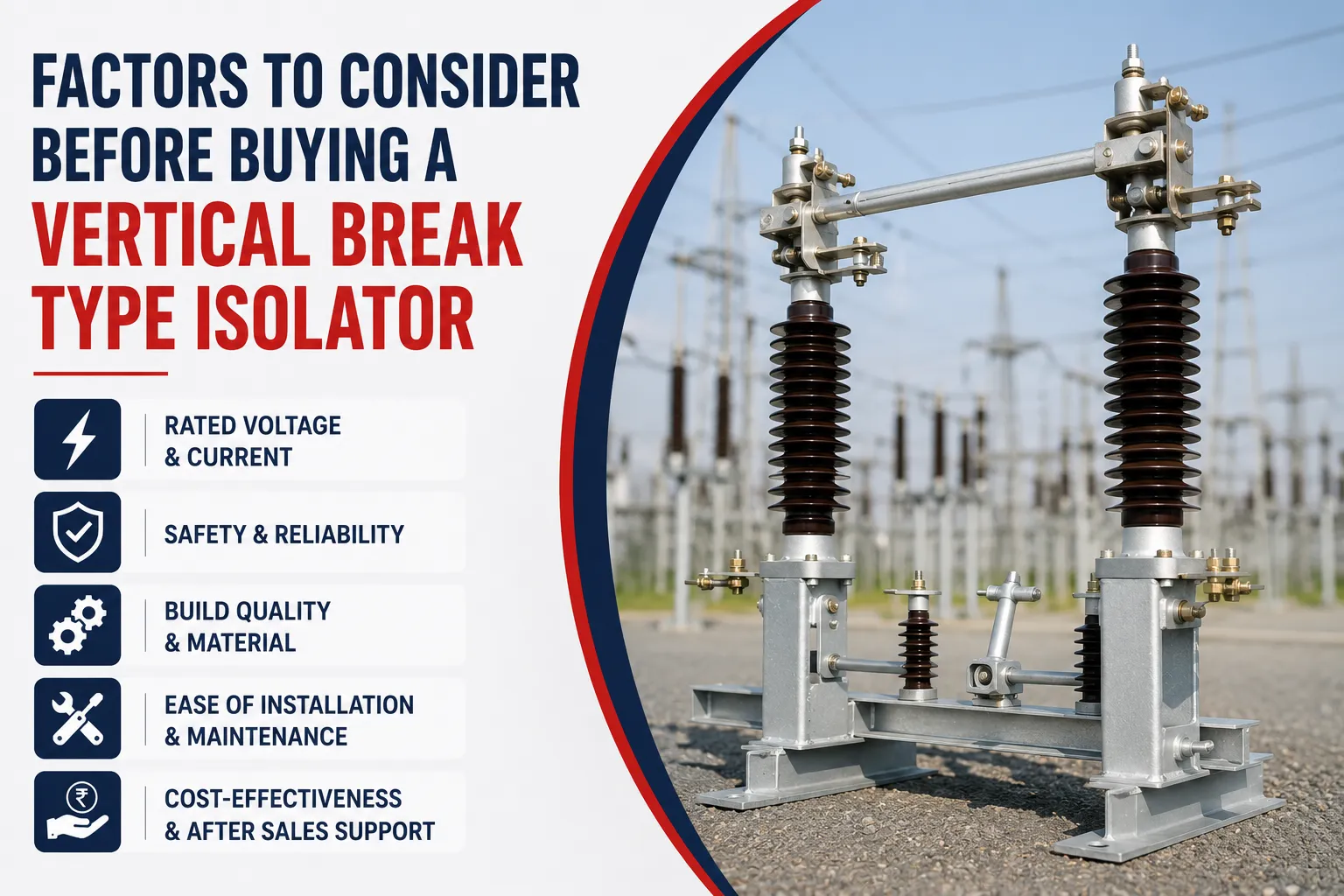
A vertical break type isolator is a common and reliable choice for many Indian substations, but only when it is specified correctly for the site conditions and load requirements. This checklist walks through every factor that actually matters before you finalize a purchase order, so you are not the procurement manager explaining an avoidable failure to your project head six months from now.
What Is a Vertical Break Type Isolator, Quickly Explained
Before running through the checklist, it helps to be clear on the basics. A vertical break isolator is a type of electrical isolator where the moving blade rotates in a vertical plane, breaking the circuit by lifting upward away from the fixed contact rather than swinging sideways like a horizontal or double break design.
This vertical opening action gives it a compact footprint and clear visible isolation, which is exactly why it remains popular across 11kV to 220kV substations in India. Understanding electrical isolation basics like this makes the rest of the buying decision much easier to evaluate.
Factor 1: Voltage Class and System Requirements
The first and most obvious factor is matching the isolator's rated voltage to your actual system voltage class. This sounds basic, but I have seen procurement teams order equipment rated for a nominal voltage that does not account for system overvoltage conditions during switching operations.
Confirm:
- Rated voltage matches your substation's actual operating class
- Impulse withstand voltage is adequate for your lightning and switching surge exposure
- Rated frequency aligns with the standard 50Hz used across Indian grids
Factor 2: Current Rating and Thermal Capacity
A vertical break type isolator needs to carry continuous load current without overheating, and also withstand short-circuit current for the duration specified by your protection scheme.
Check the following before ordering:
- Continuous current rating against your maximum expected load, with margin for future load growth
- Short-time current rating and its withstand duration, typically one or three seconds
- Temperature rise limits tested per IS and IEC standards for the contact and terminal points
In my experience, buyers sometimes size isolators exactly to present-day load without accounting for future expansion, which forces a costly replacement just a few years down the line.
Factor 3: Mechanical Design and Operating Mechanism
Since a vertical break isolator relies on precise vertical blade movement, mechanical design quality directly affects long-term reliability. A poorly designed mechanism can lead to blade misalignment, especially after repeated operation cycles or in areas with high wind loading.
Look for:
- Manual, motorized, or gang-operated mechanism options depending on your operational needs
- Interlocking provisions to prevent unsafe switching sequences with earth switches or circuit breakers
- Operating torque requirements that match your available control power or manual effort capacity
- Mechanical endurance rating, ideally backed by type test data showing thousands of operating cycles
Factor 4: Insulator Quality and Housing Material
The insulating support columns on a vertical break isolator carry both mechanical load and electrical stress, so their quality is not something to compromise on.
Consider:
- Porcelain versus polymer insulator housing, based on your site's pollution and environmental exposure
- Creepage distance suitability for your local pollution severity level
- Mechanical strength rating of the insulator columns against wind and ice loading in your region
For coastal or industrial belt installations, I generally recommend polymer housed insulators for their better performance under heavy pollution, while porcelain remains a strong choice for standard inland substations with a long proven track record.
Factor 5: Contact Design and Material
The fixed and moving contacts are where the actual electrical connection happens, and their material quality determines both current-carrying efficiency and resistance to arcing damage.
Ask your supplier about:
- Contact material, typically silver-plated copper alloy for low resistance and corrosion resistance
- Contact pressure consistency across the blade's full range of motion
- Self-cleaning wipe action during opening and closing, which reduces contact resistance buildup over time
Factor 6: Environmental and Site-Specific Conditions
An isolator installed in a coastal wind farm substation faces very different stresses than one installed in a dry inland industrial zone. Site conditions should directly influence your specification.
Factor in:
- Ambient temperature range at your installation site
- Humidity and salt exposure for coastal or industrial pollution zones
- Seismic zone rating if your project falls in a higher seismic risk area
- Altitude, since higher altitude installations may need adjusted insulation coordination
Factor 7: Compliance with IS and IEC Standards
Never finalize a vertical break type isolator purchase without confirming standard compliance and requesting supporting documentation.
Verify:
- Compliance with relevant IS standards for isolators, along with IEC 62271 series where applicable
- Type test certificates from an accredited testing station for the exact model being supplied
- Routine test reports for the specific batch being delivered to your site
Factor 8: Manufacturer's Track Record and After-Sales Support
Even a well-designed isolator needs a supplier who stands behind the product after installation. This factor gets overlooked far too often in procurement decisions focused purely on technical specification.
Evaluate:
- Manufacturer's experience supplying similar voltage class isolators to utilities or EPC contractors
- Spare parts availability for contacts, insulators, and mechanism components
- Installation and commissioning support offered alongside the equipment
- Response time for field issues during the warranty period
Quick Comparison: Vertical Break vs Other Isolator Types
| Factor | Vertical Break | Horizontal Break | Double Break (Center Break) |
|---|---|---|---|
| Footprint | Compact | Wider clearance needed | Moderate |
| Visible isolation | Clear and easy to inspect | Clear | Clear |
| Common voltage range | 11kV to 220kV | 33kV to 220kV | 11kV to 132kV |
| Ideal for | Space-constrained substations | Open-yard substations | Standard distribution substations |
Real-World Scenario: Getting It Right on a 66kV Substation
On a 66kV substation upgrade project I supported, the initial design called for a standard vertical break isolator without accounting for the site's high wind exposure near an open agricultural belt. During the review, we flagged the wind loading data against the isolator's mechanical rating and adjusted the specification to a heavier-duty mechanism with reinforced insulator support.
That single review step, done before the purchase order was placed, avoided what could have been a blade misalignment issue within the first monsoon season. This is exactly why running through a proper checklist before ordering saves far more time and cost than fixing a problem after installation.
Common Mistakes Buyers Make
Mistake: Focusing only on voltage and current rating while ignoring mechanical endurance.
An isolator that carries the right current but has a weak mechanism will still fail early under repeated operation.
Mistake: Not accounting for site-specific pollution or seismic conditions.
A specification that works in one region can underperform badly in a different environmental zone.
Mistake: Skipping test certificate verification.
Verbal assurances on IS or IEC compliance mean nothing without documented type and routine test reports.
Mistake: Overlooking after-sales support during vendor selection.
An isolator failure years into service is far more costly to resolve without a responsive manufacturer backing the product.
Industry Insight
As Indian DISCOMs continue upgrading aging distribution infrastructure and EPC contractors build out substations for renewable energy corridors, demand for reliable vertical break isolators across the 11kV to 220kV range keeps growing steadily. Buyers who apply a structured evaluation process, rather than comparing quotes alone, consistently report fewer field issues and lower long-term maintenance costs.
Why Choose SPKN India for Your Isolator Needs
SPKN India manufactures isolator disconnectors, including vertical break configurations, engineered to meet PGCIL and utility standards across voltage classes up to 220kV. As an ISO 9001:2015 certified manufacturer with over a decade of experience, every isolator undergoes type, routine, and acceptance testing in accordance with IS and IEC standards before dispatch.
Beyond manufacturing, SPKN India also provides installation and maintenance support for isolators, which means the same team that engineers your equipment can help ensure it performs correctly on site. Explore our full isolator disconnectors range or check our isolator maintenance services for ongoing support after installation.
Conclusion
Buying a vertical break type isolator is not a decision to rush through based on price comparison alone. Running through voltage class, current rating, mechanical design, insulator quality, environmental fit, standard compliance, and manufacturer support gives you a complete picture before you commit to a purchase order.
Get these factors right, and your isolator will deliver reliable electrical isolation for decades with minimal maintenance headaches. For guidance on specifying the right isolator for your project, reach out to the SPKN India team through our enquiry page.