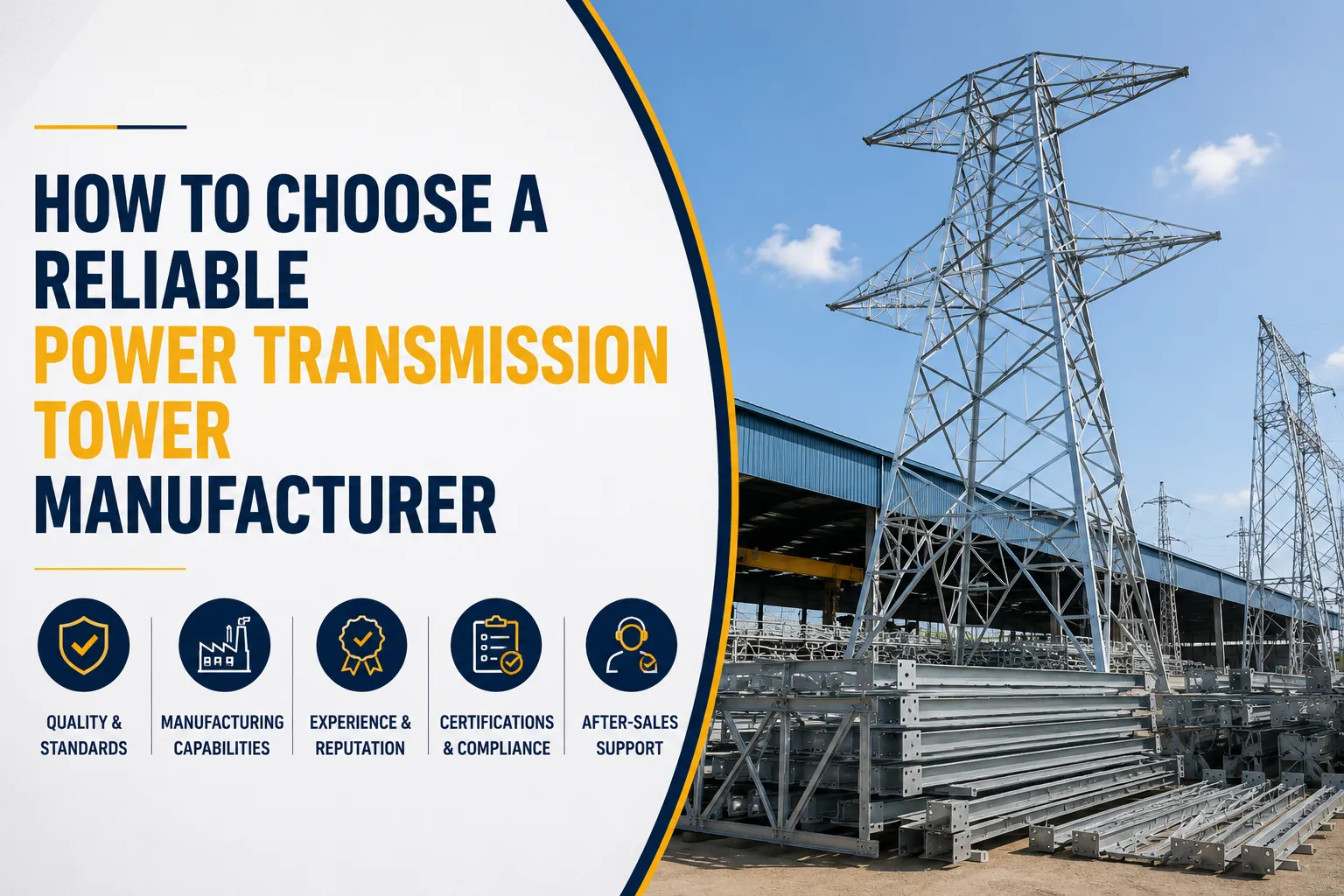
I have reviewed enough tender documents and site failures to know that most tower problems trace back to one decision made months earlier: choosing a manufacturer without properly vetting their design capability, testing process, and galvanizing quality. If you are an EPC contractor or procurement manager responsible for sourcing towers for an upcoming transmission project, this step-by-step guide walks you through exactly how to make that decision correctly.
What Is a Power Transmission Tower, and Why Selection Matters So Much
A transmission tower is a steel lattice or tubular structure designed to support overhead conductors at a safe height and distance, while withstanding wind load, ice load, conductor tension, and seismic activity across decades of service.
Unlike most electrical equipment that can be replaced relatively quickly if it fails, a transmission line tower is a long-term structural investment. Once erected across hundreds of kilometers of terrain, correcting a design flaw or material defect becomes enormously expensive and disruptive.
This is exactly why selecting the right manufacturer deserves more diligence than most buyers give it. A tower that looks identical on paper to a competitor's offering can behave very differently in the field depending on steel quality, galvanizing thickness, and fabrication tolerance.
Step 1: Understand the Type of Transmission Line Tower You Actually Need
Before evaluating manufacturers, you need clarity on which tower type your project requires. Not every electrical transmission tower serves the same purpose, and getting this wrong at the specification stage creates problems downstream.
Here are the common transmission line tower types used across Indian projects:
| Tower Type | Function | Typical Use Case |
|---|---|---|
| Suspension tower | Supports conductors in a straight line run | Standard line sections with no direction change |
| Tension (angle) tower | Withstands pull from conductor tension at line angles | Points where the line changes direction |
| Terminal tower | Anchors the line at substations or endpoints | Line termination at substation gantry |
| Transposition tower | Balances electrical characteristics across phases | Long transmission runs requiring phase transposition |
| Special towers | Custom designs for river crossings, road crossings | Unique terrain or crossing requirements |
Knowing which type or combination your route requires helps you evaluate whether a manufacturer's design and fabrication capability actually matches your project's technical demands.
Step 2: Verify Design and Engineering Capability
Once you know your tower type requirements, the next step is checking whether the manufacturer has genuine in-house structural design expertise, not just fabrication capacity.
A reliable manufacturer should be able to show you:
- Structural design calculations based on IS 802 standards for transmission line towers
- Wind load and seismic analysis specific to your project's geographic zone
- Foundation design coordination for varying soil conditions along the route
- Prototype testing reports where towers have been physically load tested before mass production
In my experience reviewing vendor submissions, the manufacturers who hesitate to share detailed design documentation are usually the ones outsourcing engineering to third parties without proper oversight. That is a risk you do not want on a multi-crore transmission project.
Step 3: Check Material Quality and Galvanizing Standards
Steel quality and galvanizing thickness determine how long a tower survives exposure to India's varied climate, from coastal humidity to industrial pollution to extreme summer heat.
Ask the manufacturer directly about:
- Steel grade used, confirmed against IS 2062 or equivalent structural steel standards
- Hot-dip galvanizing thickness, tested per IS 4759 requirements
- Coating uniformity testing across different member sizes, not just flat plates
- Corrosion resistance data from prior installations in similar environmental zones
I have seen towers installed near coastal wind farms in Gujarat and Tamil Nadu show early corrosion simply because the galvanizing coating did not meet the thickness required for that salt-heavy environment. This is precisely the kind of detail that separates an experienced high voltage transmission tower manufacturer from one cutting corners on cost.
Step 4: Confirm Manufacturing and Fabrication Capacity
A transmission line project involves hundreds or even thousands of tower structures, each with multiple steel members requiring precise fabrication. Capacity mismatch between what a manufacturer promises and what they can actually deliver is one of the most common causes of project delay.
Before finalizing a supplier, confirm:
- Monthly fabrication output capacity against your project's delivery schedule
- Whether galvanizing is done in-house or outsourced, since outsourced galvanizing often adds delay and inconsistency
- Quality control checkpoints during fabrication, not just final inspection
- Track record of delivering similar-scale orders on time for past clients
Step 5: Review Testing and Certification Documentation
Every transmission tower batch should be backed by proper testing documentation. Do not accept verbal assurances on this point.
Request:
- Type test certificates for the specific tower design, ideally from an accredited independent testing station
- Routine inspection reports for dimensional accuracy and weld quality
- Third-party inspection agency reports if your project mandates them
- Compliance documentation against relevant IS and IEC standards for structural steel towers
Step 6: Evaluate Logistics and On-Site Support
Transmission towers are transported in sections and assembled on site, often in remote or difficult terrain. A manufacturer's logistics planning matters as much as their fabrication quality.
Ask about:
- Packing and labeling systems that make site assembly straightforward for erection teams
- Transport coordination for remote or hilly project locations
- Technical support availability during erection, especially for first-time crews on a new tower design
- Spare member availability in case of transport damage or site-specific adjustments
Step 7: Check References and Past Project History
Finally, ask for references from actual utilities, DISCOMs, or EPC contractors who have used the manufacturer for comparable transmission projects. A manufacturer confident in their work will share this without hesitation.
Look specifically for:
- Projects of similar voltage class and route length to yours
- Feedback on delivery timeline adherence
- Any post-installation issues and how they were resolved
Real-World Example: Why Vetting Matters
On a 132kV transmission line project I was involved with, one bidder offered towers at a notably attractive rate but could not produce independent type test certificates for their specific design when asked. The project team passed on that bidder despite the lower cost, choosing a manufacturer who could document every claim with test reports and prior project references.
That decision paid off during commissioning, when the towers passed every inspection without a single rework requirement. The lesson holds true across almost every transmission project I have reviewed: documentation discipline at the sourcing stage predicts field performance far better than price alone.
Common Mistakes Buyers Make When Sourcing Transmission Towers
Mistake: Selecting based on quoted cost without verifying design credentials.
A lower quote often means shortcuts somewhere, whether in steel grade, galvanizing thickness, or engineering rigor.
Mistake: Not confirming galvanizing standards for the specific installation environment.
Coastal, industrial, and high-humidity zones require different corrosion protection than standard inland installations.
Mistake: Ignoring manufacturing capacity against project timelines.
A manufacturer without adequate capacity will either delay your project or subcontract fabrication without proper oversight.
Mistake: Skipping third-party testing verification.
Self-certified test reports without independent verification carry real risk on structural components meant to last decades.
Common Myths About Transmission Tower Sourcing
Myth: All transmission towers built to the same voltage rating are essentially identical.
Fact: Design load calculations, steel grade, and galvanizing standards vary significantly between manufacturers even for the same voltage class.
Myth: Domestic manufacturers cannot match international quality benchmarks.
Fact: ISO certified Indian manufacturers with proper testing protocols routinely meet the same IS and IEC standards required for international-grade projects.
Industry Insight
India's transmission network continues expanding rapidly as new renewable energy corridors connect wind and solar generation zones in Gujarat, Rajasthan, and Tamil Nadu to the national grid. This expansion is driving sustained demand for both standard and special transmission towers designed for challenging terrain and long-distance routing.
For EPC contractors bidding on these corridors, having a vetted, capacity-verified tower manufacturer relationship in place before tendering provides a genuine competitive advantage on both cost certainty and delivery reliability.
Why Choose SPKN India for Your Transmission Line Hardware and Structures
While evaluating your power transmission tower manufacturer, it is worth remembering that a tower is only as reliable as the hardware and fittings mounted on it. SPKN India manufactures the critical line materials that complete a transmission structure: substation gantry structures, connectors, clamps, insulators, and lightning arresters, all built to IS and IEC standards for voltage classes up to 220kV.
As an ISO 9001:2015 certified company with over a decade of experience supplying utilities, DISCOMs, and EPC contractors across India, SPKN India understands what a transmission project actually needs at the structural and hardware level, tested, certified, and delivered on schedule. Explore our substation gantry structure range or check our full products catalog to see how our hardware complements your tower procurement.
Conclusion
Choosing a reliable power transmission tower manufacturer is not a decision to rush through a standard tender comparison. It requires verifying design engineering, material quality, fabrication capacity, and testing documentation, step by step, before a single tower reaches your project site.
Get these fundamentals right, and your transmission line will stand reliably for decades. Get them wrong, and you are looking at costly rework across a route that spans hundreds of kilometers. For sourcing support on transmission line hardware, connectors, or substation structures, reach out to the SPKN India team through our enquiry page.