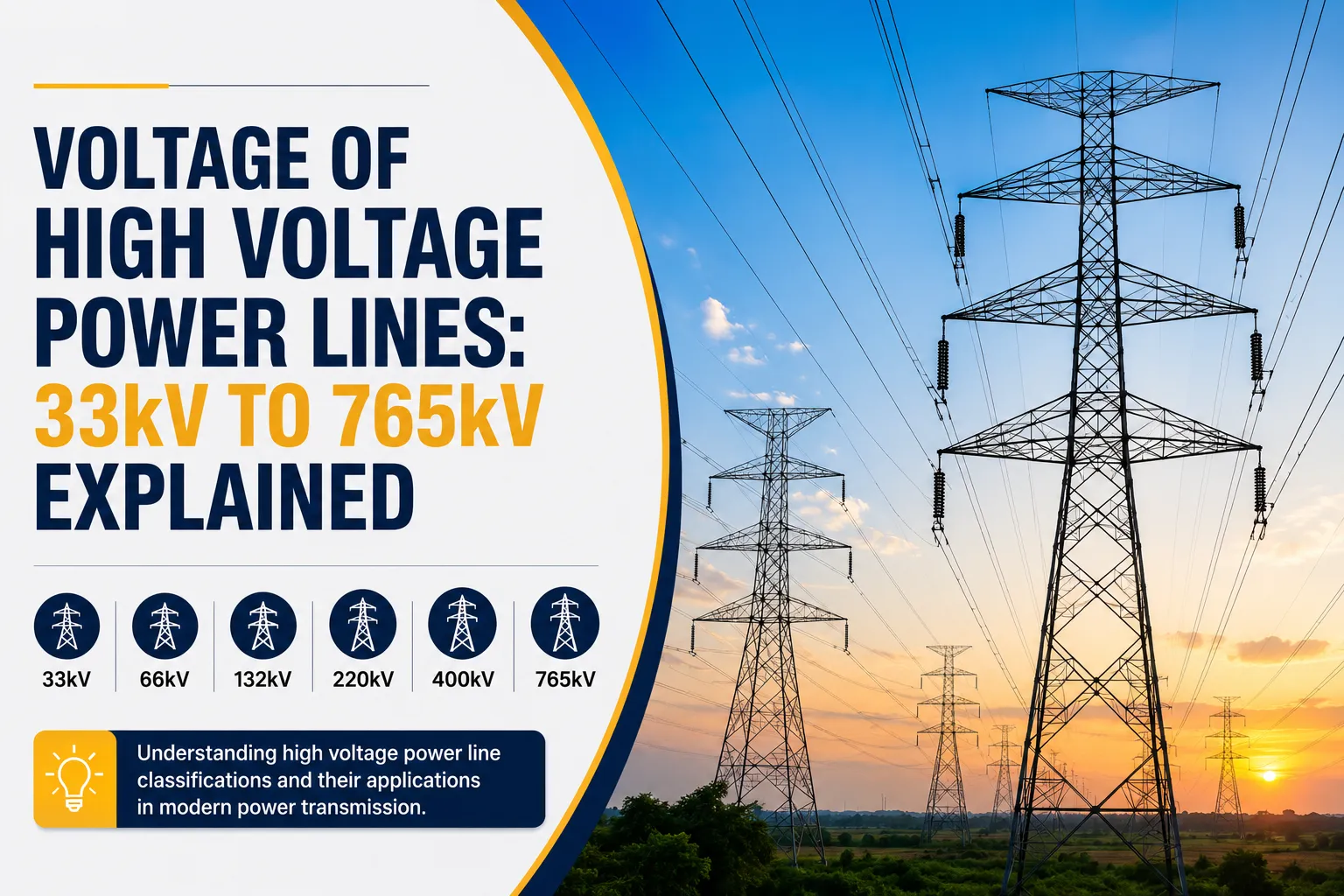
In my years reviewing transmission planning documents, the same question comes up repeatedly from people new to the field: why does India use so many different voltage levels instead of just one standard? The answer lies in matching voltage to distance and load, not in inconsistency. A city distribution feeder and a state-to-state bulk power corridor have completely different requirements, and the voltage class reflects that.
Why Voltage Classification Exists in the First Place
Electrical power systems are built in layers, moving from generation down to the end consumer through progressively lower voltage stages. Each stage exists because there is an ideal voltage range for that specific job.
The general logic works like this:
- Higher voltage means lower current for the same power, which reduces I squared R losses over long distances
- Lower voltage is safer and more practical for final delivery to homes, shops, and smaller industrial loads
- Equipment cost and insulation requirements increase with voltage, so utilities do not run high voltage lines any further into the network than necessary
This is why a single power unit generated at a plant might pass through four or five different voltage levels before it reaches a household socket.
Voltage Classes Used in Indian High Voltage Power Lines
India's transmission and sub-transmission network is organized around a defined set of standard voltage classes, each serving a specific role.
| Voltage Class | Category | Typical Role |
|---|---|---|
| 11kV to 33kV | Sub-transmission | Feeding distribution substations from grid substations |
| 66kV | Sub-transmission | Regional power distribution to industrial and urban load centers |
| 132kV | Transmission | State-level bulk power transfer between substations |
| 220kV | Transmission | Inter-regional and long-distance bulk power transfer |
| 400kV | Extra High Voltage (EHV) | National grid backbone, large generating station evacuation |
| 765kV | Extra High Voltage (EHV) | Very long-distance bulk transmission corridors |
| Above 765kV (HVDC) | Ultra High Voltage | Point-to-point bulk power transfer over very long distances |
This table reflects the general structure followed across most Indian state transmission utilities and Power Grid corridors, though exact voltage levels used in a given region depend on that state's specific grid planning.
Understanding Each Voltage Class in Detail
11kV and 33kV: The Distribution Backbone
These voltage levels handle the bulk of local power distribution. A 33kV line typically feeds a distribution substation, which then steps down further to 11kV for feeding local transformers that finally bring power down to 415V or 230V for end use. Most switch disconnectors and drop out fuse installations that engineers encounter regularly operate within this voltage band.
66kV: Regional Distribution
This voltage class often serves as a middle layer in areas with significant industrial load, feeding power from grid substations to zonal substations without requiring the additional cost and land footprint of a full 132kV installation. In my experience working with industrial clients, captive power arrangements and larger manufacturing units often interface with the grid at this voltage level.
132kV: State-Level Bulk Transfer
A 132kV line typically connects state transmission substations, moving power between regions within a state or from a generating station to a load center. This is one of the most common voltage classes for EPC contractors working on state transmission projects, since it balances transfer capacity with manageable tower and right-of-way requirements.
220kV: Inter-Regional Transmission
220kV lines handle larger volumes of power over longer distances, often connecting different regions of a state grid or linking to neighboring state networks. Insulation coordination and clearance requirements step up meaningfully at this level compared to 132kV, which affects tower design, insulator string length, and substation equipment specification.
400kV: The National Grid Backbone
400kV forms a major part of India's interstate transmission backbone, evacuating power from large thermal, hydro, and renewable generating stations into the national grid. Lines at this voltage class typically use bundle conductor configurations to manage corona discharge and maintain acceptable audible noise and radio interference levels.
765kV: Long-Distance Bulk Corridors
765kV represents the highest AC transmission voltage class actively used in India's grid, designed specifically for very long-distance bulk power transfer where the efficiency gain from higher voltage justifies the significantly higher tower, insulator, and right-of-way costs involved.
HVDC: Beyond Standard AC Voltage Classes
For extremely long-distance point-to-point transmission, particularly linking distant generating regions to major load centers, High Voltage Direct Current systems are used instead of standard AC voltage classes, since HVDC avoids certain AC transmission losses over very long distances.
How Voltage Affects Line Design and Equipment Selection
The voltage of a high voltage transmission line directly influences almost every physical design decision:
- Insulator string length increases with voltage class to maintain adequate insulation coordination against switching surge and lightning impulse
- Conductor bundle configuration becomes necessary at 400kV and above to control corona discharge at the conductor surface
- Tower height and clearance requirements increase with voltage to maintain safe ground clearance and phase-to-phase spacing
- Substation equipment rating, including circuit breakers, isolators, and lightning arresters, must match the specific voltage class and associated insulation level
Selecting equipment rated for the wrong voltage class is not a minor specification error. It creates a genuine safety and reliability risk that will surface the first time the system experiences a switching surge or lightning event.
Comparing Voltage Classes: Advantages and Limitations
| Voltage Class | Advantages | Limitations |
|---|---|---|
| 33kV and below | Lower equipment cost, simpler tower structures, easier maintenance access | Higher current for given power, more line losses over distance |
| 66kV to 132kV | Good balance of transfer capacity and infrastructure cost | Limited to regional or state-level distances before losses become significant |
| 220kV to 400kV | Efficient for long-distance bulk transfer, supports large generating station evacuation | Higher tower, insulator, and right-of-way costs; larger clearance requirements |
| 765kV and HVDC | Maximum efficiency for very long-distance transfer | Highest infrastructure cost, requires specialized equipment and skilled workforce for construction and maintenance |
Industry Standards Governing Voltage Classification
- CEA guidelines define technical standards for construction of electrical plants and electric lines, including voltage classification and clearance requirements
- IS and IEC standards specify insulation coordination requirements for each voltage class, covering switching surge and lightning impulse withstand levels
- CBIP guidelines provide practical recommendations for transmission line design parameters specific to Indian grid conditions
- Power Grid specifications define technical requirements for equipment used on the interstate transmission system at 220kV, 400kV, and 765kV levels
Common Mistakes When Working with Different Voltage Classes
- Assuming equipment rated for one voltage class can be safely used at an adjacent class without proper insulation coordination review
- Underestimating clearance requirements when planning line routes near existing infrastructure at a different voltage level
- Confusing nominal voltage with maximum system voltage, which affects equipment rating selection
- Overlooking the difference between phase-to-phase and phase-to-ground voltage when specifying insulation levels
- Assuming all 33kV or 132kV lines across different states follow identical design practices, when in practice each state transmission utility may have specific variations
Safety Considerations Around High Tension Lines
High tension electricity carries serious risk, and safe working distance requirements exist precisely because higher voltage classes require greater clearance to prevent flashover, even without direct contact. Anyone working near or under high tension lines, whether for construction, agriculture, or maintenance work, must maintain the statutory safe distance defined for that specific voltage class under CEA regulations.
Safety warning: never assume a de-energized appearance means a line is safe. All work near transmission lines, regardless of voltage class, must follow proper permit-to-work, isolation, and earthing procedures carried out by authorized personnel only.
Future Trends in Voltage Level Planning
As renewable energy generation, particularly solar and wind capacity in resource-rich states, continues to grow, transmission planning increasingly focuses on strengthening 400kV and 765kV corridors to evacuate power from remote generation sites to major load centers. HVDC links are also expanding as a solution for connecting distant renewable generation clusters without the transmission losses associated with very long AC lines at lower voltage classes.
Why Voltage-Appropriate Equipment Selection Matters
Choosing equipment that matches the exact voltage class and insulation level of a project is one of the most fundamental decisions in transmission and substation design, yet it is sometimes treated as a formality rather than a technical evaluation. A manufacturer that understands the specific insulation coordination and clearance requirements at each voltage class, rather than simply supplying based on a nameplate number, adds real value to project reliability.
SPKN India manufactures and supplies High Voltage Switching Equipment, Electrical Isolators, Air Break Switches, GOAB Switches, Lightning Arresters, and Substation Equipment across multiple voltage classes used in Indian transmission and distribution networks, supporting EPC contractors, DISCOMs, and industrial clients with equipment matched to project-specific voltage and insulation requirements. For projects requiring complementary Transmission Line Hardware or Earthing solutions across different voltage classes, coordinating with a supplier experienced across the full voltage range often simplifies technical planning.
Conclusion
The voltage of a high voltage power line is determined by the distance power needs to travel and the amount of load it must carry, not by arbitrary convention. From 33kV distribution feeders to 765kV bulk transmission corridors, each voltage class exists to balance transfer efficiency against infrastructure cost and safety requirements. Understanding these voltage classes helps engineers, EPC contractors, and procurement teams select equipment that genuinely matches project requirements rather than relying on assumption. SPKN India supports transmission and distribution projects across these voltage classes with equipment and technical guidance suited to India's grid requirements.