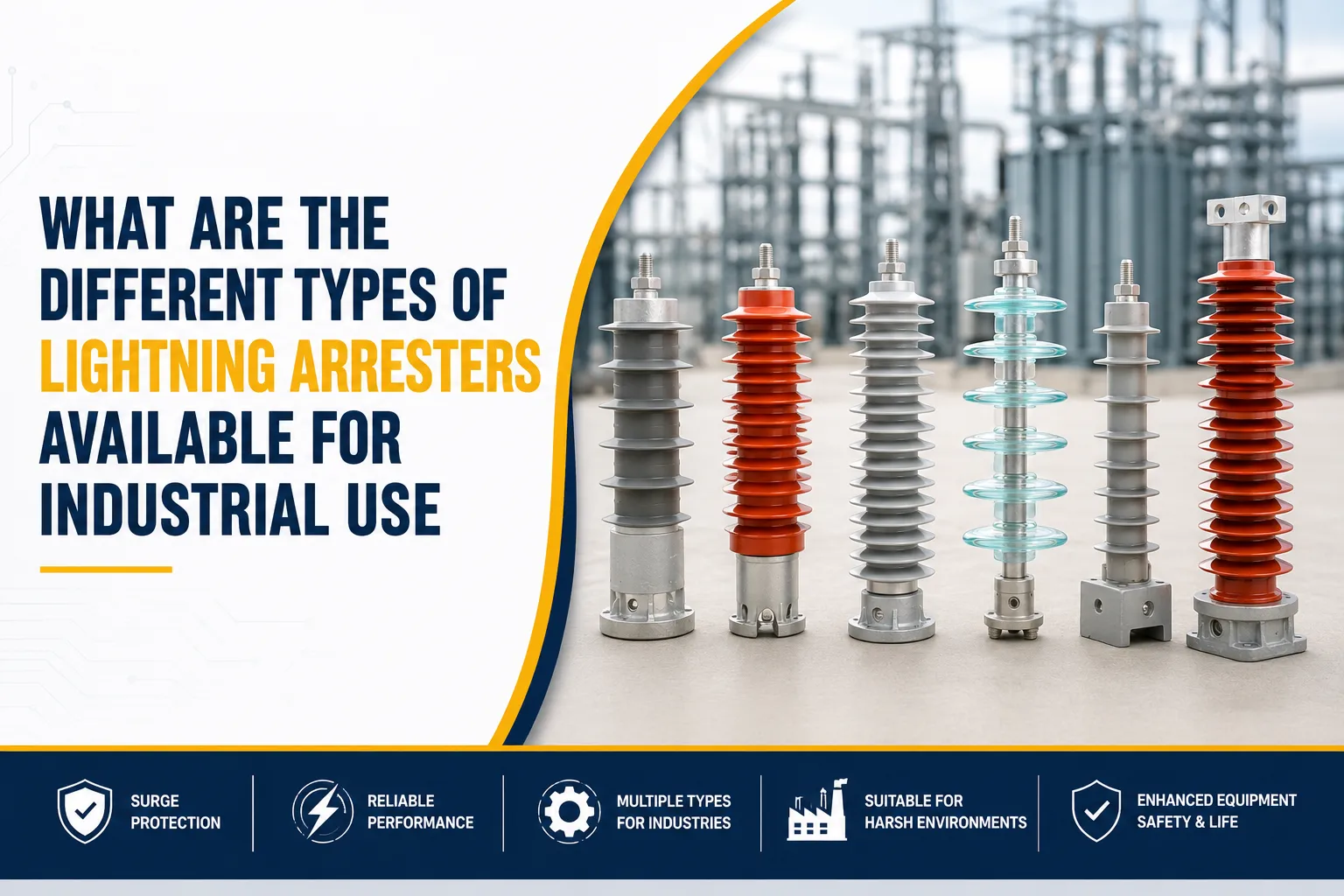
If you are an EPC contractor, procurement manager, or plant engineer sourcing protection equipment, understanding the different types matters more than most people realize. Not every application needs the same lightning arrester, and picking blind can cost you far more in downtime than the equipment itself. This guide breaks down the main types used in Indian industry today, where each one fits, and how to choose correctly, straight from working with lightning arrester suppliers in India who build for real grid conditions, not lab conditions.
What Is a Lightning Arrester, Exactly?
Before comparing types, it helps to be clear on the basics. So, what is a lightning arrester?
A lightning arrester is a protective device connected between a live conductor and earth. Its job is simple: when a voltage surge from lightning or switching hits the line, the arrester diverts that excess energy safely into the ground before it reaches your transformer, switchgear, or motor windings.
Under normal operating voltage, the arrester stays inactive and does not interfere with the circuit. The moment a surge crosses its threshold, it conducts, discharges the surge to earth, and then returns to its non-conducting state. That cycle needs to happen in microseconds, which is why the internal design of an arrester matters so much.
Why the Type of Arrester You Choose Actually Matters
In my experience visiting substations across Haryana and neighboring states, I have seen plants install a distribution class arrester on a line that really needed a station class unit, simply because nobody explained the difference at the buying stage.
The result is usually one of two outcomes. Either the arrester fails prematurely under repeated surge duty, or it lets through more energy than the connected equipment can safely absorb. Both scenarios lead to the same place: an unplanned shutdown and an expensive repair bill.
This is exactly why understanding lightning arrester types before you finalize a purchase order is not optional homework. It is basic risk management for anyone running industrial or utility infrastructure.
7 Types of Lightning Arresters Used in Industrial Applications
Here is a practical breakdown of the arrester types you will actually encounter when sourcing for industrial, substation, or building protection.
1. Rod Gap Arrester
This is the simplest and oldest form of surge protection. It consists of two metal rods separated by an air gap, one connected to the line and the other to earth.
When voltage exceeds a set level, the air gap breaks down and current flows to ground through a spark. Once the surge passes, the arc has to be manually or naturally extinguished.
Rod gap arresters are inexpensive to manufacture but offer limited protection precision. They are largely used as a backup protection layer today rather than a primary defense, since the discharge voltage is not tightly controlled.
2. Horn Gap Arrester
A horn gap arrester improves on the basic rod gap design using two curved, horn-shaped electrodes. When the arc forms during a surge, rising hot air and the shape of the horns cause the arc to travel upward and stretch until it breaks naturally.
This self-extinguishing action is a real advantage over the plain rod gap. Horn gap arresters are still widely specified for 11kV and 33kV distribution networks in India because they are rugged, low-maintenance, and cost-effective for moderate protection needs.
3. Expulsion Type (Tube) Arrester
Expulsion arresters use a fiber tube lined internally with a material that releases gas when heated by an arc. During a surge, the internal arc generates gas pressure that physically expels the ionized air, extinguishing the arc quickly.
These are commonly used on overhead distribution lines and rural feeders where surges are frequent but equipment value is comparatively lower. In my experience inspecting rural 11kV feeders, expulsion types hold up well against repeated lightning activity typical of open agricultural terrain.
4. Valve Type (Silicon Carbide) Arrester
Valve type arresters use a series gap combined with silicon carbide (SiC) resistor blocks. Under normal voltage, the resistor blocks and gap keep the arrester non-conducting.
During a surge, the gap sparks over and the SiC blocks conduct the surge current to ground while limiting the follow current from the power system. Once the surge clears, the gap interrupts the follow current automatically.
This design was the industry standard for decades on transmission and substation equipment before metal oxide technology took over. You will still find SiC valve type arresters in older substations across India that have not yet been upgraded.
5. Metal Oxide (Gapless ZnO) Arrester
This is the modern standard for most industrial and utility applications today. Metal oxide arresters use zinc oxide (ZnO) blocks with a highly non-linear voltage-current characteristic, which means they conduct almost nothing at normal voltage but respond instantly and heavily once a surge hits.
Because there is no spark gap involved, response time is faster and there is no arc-related wear over the arrester's life. Metal oxide arresters are now the preferred choice for 11kV through 220kV substations, transformer protection, and critical industrial feeders.
They also handle repeated switching surges better than valve type designs, which matters a great deal for plants running heavy motor loads with frequent starts and stops.
6. Polymer (Silicone) Housed Surge Arrester
The housing material matters as much as the internal technology. Polymer housed arresters use silicone rubber sheds instead of porcelain, giving them better resistance to pollution flashover, lighter weight, and higher mechanical strength.
For coastal installations, industrial belts with heavy air pollution, or wind and solar farms where transport and handling matter, polymer housed metal oxide arresters have become the go-to choice. I have specified these on windmill substation projects in Gujarat and Tamil Nadu specifically because the reduced weight simplifies tower-top installation.
7. Porcelain Housed Surge Arrester
Porcelain housing remains widely used, particularly in conventional substations where long-term dimensional stability and proven field history carry more weight than reduced weight. Porcelain is highly resistant to UV degradation and offers excellent electrical insulation over decades of service.
The tradeoff is higher weight and a slightly greater risk of shattering under mechanical impact compared to polymer housing. Many utilities in India still prefer porcelain for station class applications where the arrester is fixed and well protected within the substation yard.
Quick Comparison: Which Type Fits Where
| Arrester Type | Best Suited For | Typical Voltage Range |
|---|---|---|
| Rod Gap | Backup or basic protection | Low voltage |
| Horn Gap | Distribution feeders | 11kV to 33kV |
| Expulsion (Tube) | Rural overhead lines | 11kV to 33kV |
| Valve Type (SiC) | Older substations, transmission | 33kV to 132kV |
| Metal Oxide (ZnO) | Modern substations, industrial feeders | 11kV to 220kV |
| Polymer Housed | Coastal, polluted, or wind/solar sites | 11kV to 220kV |
| Porcelain Housed | Conventional fixed substations | 11kV to 220kV |
Real-World Applications Across Industries
Substations: Station class metal oxide arresters protect power transformers, busbars, and circuit breakers from both lightning and switching surges at grid interconnection points.
Textile and manufacturing units: A single voltage spike can damage variable frequency drives and PLC-based control systems worth lakhs. Distribution class arresters at the incoming supply point are a standard safeguard here.
Wind and solar installations: Turbines and inverter stations sit exposed in open terrain, making them frequent lightning targets. Polymer housed arresters are specified for their weight advantage during tower-top and rooftop installation.
Residential and commercial buildings: For a lightning arrester for building applications, lower capacity distribution class units protect incoming service lines and rooftop equipment from direct and induced surges.
Buyer's Checklist: How to Choose the Right Lightning Arrester
Before you finalize an order, run through these points:
- Confirm the system voltage and class required (distribution, intermediate, or station class)
- Check the housing material based on site conditions (pollution, coastal exposure, mechanical risk)
- Verify IS and IEC compliance along with type test certificates
- Match the discharge current rating to your equipment's surge withstand capacity
- Ask about creepage distance, especially for polluted or high-humidity zones
- Confirm earthing compatibility since even the best arrester fails without a proper earth path
- Check after-sales and replacement support from the supplier, not just the initial supply
Common Myths About Lightning Arresters
Myth: One arrester protects the entire plant.
Fact: Arresters protect the equipment closest to their point of installation. Large facilities need arresters at multiple points, not just the main incomer.
Myth: A more expensive arrester always means better protection.
Fact: Correct sizing and class selection matter far more than cost tier. An oversized or wrongly rated unit can underperform a correctly specified one.
Myth: Once installed, arresters need no maintenance.
Fact: Arresters degrade with repeated surge duty and should be inspected periodically, especially after a severe storm season.
Industry Insight
Lightning activity across India's northern and eastern belts has been tracked closely by meteorological agencies over the past decade, and the data consistently shows monsoon months carrying the highest strike density nationwide. For any EPC contractor working on transmission or distribution projects in these zones, arrester specification is not a line item to shortcut. It is one of the few components standing between a surge event and a multi-lakh equipment failure.
Why Choose SPKN India for Lightning Arresters
SPKN India manufactures and supplies a full range of lightning arresters, including horn gap and metal oxide types, built to IS and IEC standards for voltage classes up to 220kV. Every unit goes through type, routine, and acceptance testing before it leaves the facility, so utilities and industrial buyers can rely on consistent performance in the field.
As an ISO 9001:2015 certified manufacturer with over a decade of experience supplying substations, EPC contractors, and industrial units across India, SPKN India understands the practical difference between an arrester that works on paper and one that survives an actual monsoon season. You can explore the full range on the lightning arresters product page or check the related horn gap fuse range for complete feeder protection.
Conclusion
Choosing among the different lightning arrester types is not about picking the most advanced option available. It is about matching the arrester class, housing, and rating to your actual site conditions, voltage level, and equipment sensitivity.
Whether you are protecting a rural 11kV feeder, a coastal wind farm, or a 220kV substation, working with experienced lightning arrester suppliers in India ensures you get equipment engineered for Indian grid realities, not generic specifications. For sourcing support or technical guidance on the right arrester for your project, reach out to the SPKN India team directly through the contact page.