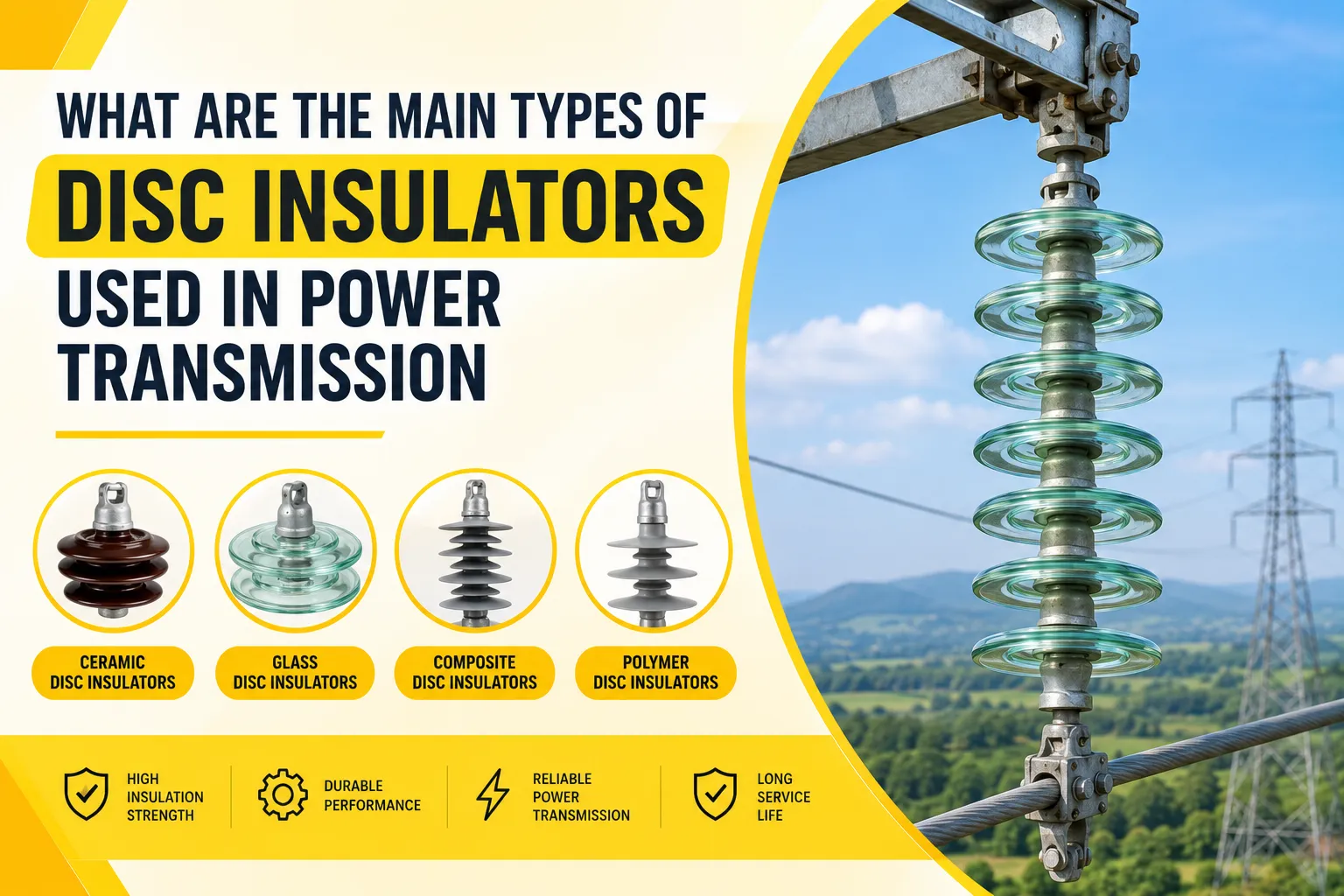
Every disc in that insulating string is performing a very specific job function; keeping thousands of volts of electricity off the steel tower, the ground, and any people walking by. Get the wrong disc insulator, and you're looking at flashovers, tripping, unplanned outages, and in the worst case, safety incidents on a live line.
For electrical engineers, procurement managers, and EPC contractors building substations and transmission lines across India, knowing the different types of disc insulators is a critical skill set that directly impacts reliability, maintenance cost, and performance in monsoon season, coastal humidity, or industrial pollution.
In this guide, you'll learn everything about the different types of disc insulators used in India for transmission lines today, what function they serve, where they should be used, and why. All from the perspective of a manufacturer and field applicator, like SPKN India, advising electric utilities and contractors on the right disc insulators for the job.
What Exactly Is a Disc Insulator?
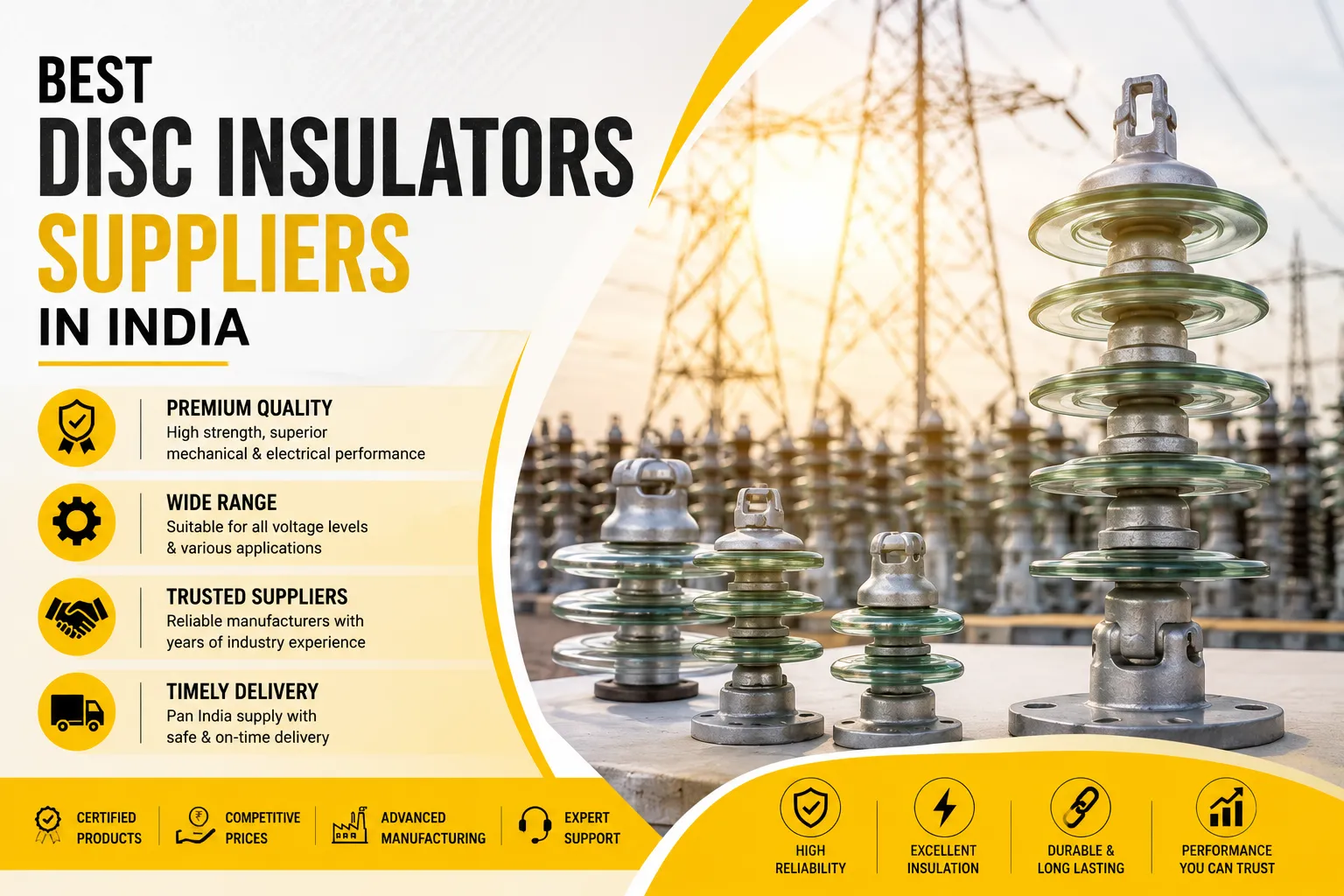
A disc insulator, sometimes referred to as a disc type insulator, is basically one individual disc of insulation having a metal cap on one side and a metal pin on the other. Disc insulators are connected into strings of various lengths, cap to pin, for use as an insulator string.
The number of discs used in a string is dependent upon the voltage being insulated. The lower the voltage, the less discs are needed in the string. A standard 11kv disc insulator string will have a reduced number of discs when compared to a 33kv disc insulator string.
The most significant advantage that the disc type insulator has over the long-rod or pin type insulators is the fact that it can be used in sections. A section of insulator is made up of a number of discs connected together. If a disc within the section becomes damaged, for example, by a lightning strike, only the damaged disc needs to be replaced. This could be a very important factor for a utility or industrial power company.
Main Types of Disc Insulators Used in Power Transmission Essay
The following are the main types of disc insulators found on the Indian transmission and distribution systems, categorized by the materials used in their construction, their general design, and application:
1. Standard (Normal type) Disc Insulators
Standard type disc insulators are the most common disc insulators used throughout India on transmission towers where pollution levels are moderate, and abnormal stresses are absent.
- Uniform spacing between the under ribs
- Uniform creepage distance suitable for general applications
- Used widely for 11, 33, 66, and 132 kV lines
- Most cost-effective solution for large-scale rural and urban distribution projects
The standard type disc insulators are the preferred choice for radial distribution feeders in the states of Haryana, Uttar Pradesh, and Rajasthan due to their cost-effectiveness, reliability, and lower overall stringing costs for distribution purposes. This is especially true for the DDUGJY and feeder separation initiatives currently underway in these states.
2. Anti-Fog (Aerodynamic) Disc Insulators
In coastal areas where heavy fog, salt laden atmosphere and industrial pollution are a norm, the normal disc insulator is not sufficient. Contamination on the surface leads to moisture bridge resulting in flashover even at normal operating voltages.
Anti fog disc insulators have
- deeper and more aerodynamic under ribs which shed off the contamination and moisture
- higher creepage distance for the same number of discs as compared to conventional discs.
- better self cleaning properties when subjected to rain
These are widely used in coastal areas of Tamil Nadu, Gujarat, Maharashtra by TANGEDCO, PGVCL, MSEDCL to prevent flashover due to heavy salt content in air.
3. Porcelain Disc Insulators
Porcelain remains the traditional material used for disc insulators and is one of the preferred insulator materials in the Indian electrical industry.
Strengths of porcelain specified in electric power systems in India:
- Good mechanical strength for spanning long distances between towers
- Proven performance over decades of service
- Predictable aging characteristics for easy condition assessment
- Resistance to UV light degradation
Porcelain disc insulators are the preferred choice for 33kV and 66kV substation strings where high mechanical strength is required over long transmission spans.
4. Toughened Glass Disc Insulators
The key principle of a toughened glass disc insulator is that when internal damage occurs (through manufacturing defects, lightning strikes, or vandalism) the insulator will visibly shatter rather than merely crack like porcelain.
This makes glass insulators ideal for:
- Long overhead transmission lines, where it is impractical to inspect every single string of insulators for damage
- On transmission lines subject to stone throwing or vandalism
- On distribution lines rated over 66kV, where early fault detection is critical.
In situations where line crews can most benefit from being able to see a damaged insulator from the ground, without having to climb up and perform a thermal imaging survey.
5. Polymer (Composite) Disc Insulators
The newest type of insulator on the list, polymer disc units include a fiberglass rod core with silicone rubber or EPDM sheds molded onto it, rather than ceramic or glass.
Some advantages of this type which have led to increased popularity:
- Much lighter, making it easier to string up on transmission towers
- Hydrophobic (water-repelling) surfaces reduce chances of contamination flashover
- Less susceptible to vandalism due to lack of easily-breakable ceramic parts
- Superior performance in high-pollution industrial areas
Many EPC contractors are beginning to specify polymer disc insulators for new transmission projects in industrial clusters, or near large cement or steel manufacturing facilities, where particulate-laden air tends to settle on traditional porcelain discs.
6. Cap and Pin Disc Insulators (By Voltage Class)
While cap and pin is technically the construction style shared by the majority of disc insulators, it is best to separate them according to voltage class as the specification tends to change considerably:
| Voltage Class | Typical Use Case | Disc Count (Approx) |
|---|---|---|
| 11kV disc insulator | Distribution feeders, local substations | 1 to 2 discs |
| 33kv disc insulator | Sub-transmission lines, industrial feeders | 3 to 4 discs |
| 66kV and above | Main transmission corridors | 5 or more discs |
An 11kv disc insulator string is designed for shorter distances, while a 33kv disc insulator string is generally made with several more discs and an increased creepage distance in order to properly isolate the larger voltage class.
Where Disc Insulators Are Applied
It may help to focus on these in a practical context before looking at specifications:
- Substation gantries: Standard and porcelain disc insulators are used for incoming and outgoing feeder bays.
- Overhead transmission towers: Toughened glass or anti-fog disc insulators are used for long-span, high-voltage overhead lines.
- Industrial power yards: Polymer disc insulators are increasingly used in proximity to industrial plants where dust and chemical fumes can accumulate on insulator surfaces.
- Coastal and high-humidity areas: Anti-fog disc insulators prevent flashover due to contamination during periods of monsoon and post-monsoon humidity.
- Windmill and solar evacuation lines: Light-weight polymer disc insulators reduce tower loading on remote renewable energy substations.
Benefits of Choosing the Right Disc Insulator
The importance of choosing the right type is not just a technical detail, but rather directly impacts on the performance of a utility's operations:
- fewer unplanned outages due to flashover or contamination
- lower long-term maintenance costs by reducing the rate of degradation of properly chosen insulators
- improves worker safety during live line maintenance and inspection
- helps achieve compliance with utility and PGCIL specifications
- prolongs the life of the installation across the 25 to 40 year design life of transmission infrastructure
A buyer's checklist before finalizing disc insulators
Procurement managers and EPC contractors should ensure that the following aspects are covered before going ahead for the procurement of porcelain insulators:
- The voltage class of the line (11kV, 33kV, 66kV, or higher), which decides the number of discs and creepage distance requirement.
- The pollution severity of the location of installation-light, medium, heavy, or very heavy as per IS and IEC pollution classification.
- The material like porcelain or glass for normal corridor or polymer or anti fog insulators for coastal areas and industrial areas.
- The mechanical stress rating appropriate for the span length and tension requirement of the conductor.
- Type test and routine test conformity as per IS 731 and IEC 60305/60383.
- Manufacturer's reputation and after-sales service and support for providing spares in case of replacements.
Common myths about disc insulators
Myth: More discs provide more insulation.
Fact: The number of discs is determined by a combination of voltage and pollution conditions. Extra discs specify unnecessary mechanical loading on the tower.
Myth: Glass insulators are old technology.
Fact: Glass disc insulators are specified on many transmission line projects because of the benefit of seeing the self-destructing insulator during visual patrols.
Myth: Polymer discs are not suitable for transmission work.
Fact: Polymer disc technology is being used on many sub-transmission and industrial distribution circuits.
Myth: All disc insulators are basically the same.
Fact: There are significant differences in design and materials that influence flashover performance.
Why Choose SPKN India for Disc Insulators
SPKN India has been manufacturing and supplying high voltage line materials like isolators, insulators, and substation hardware for over a decade to utilities, industries, and EPC contractors across the country.
Here are the reasons why you should choose SPKN India’s disc insulators:
- Disc insulators manufactured in ISO 9001:2015 certified facilities with rigorous quality checks at every production stage
- Type, routine, and acceptance tests conducted on all items as per IS and IEC standards before delivery
- Proven designs that have been tested and installed in more than 1100+ projects across the state and the country
- Technical support to determine the appropriate disc insulator type based on pollution level and voltage grade
- We offer a complete range of disc insulators that cater to the needs of 11kV distribution lines as well as 66kV transmission lines
Whether your procurement requirement falls under a government DISCOM tender or an EPC turnkey project, SPKN India’s technical team will advise you on the most suitable disc insulator type instead of a generic specification.
Conclusion
While transmission line insulators may seem like a small, dull part of the larger electrical infrastructure, choosing the wrong type can have a serious impact on the performance and safety of the whole system. Different types and sizes of disc insulators have their own sets of advantages that make them more suited to particular applications like standard, anti-fog, porcelain, toughened glass, or the newer polymer disc insulators.
If you have a project that requires new equipment installation, upgrades to an existing feeder, or any other modifications involving insulator discs suitable for a particular voltage class, contact SPKN India technical support representatives. They will advise you on the best choice of disc insulator type and size as per your requirements while considering the demands of the local environment. All our products are manufactured to international ISO standards and have been proven reliable in hundreds of substation electrification and transmission line construction projects across the country.